
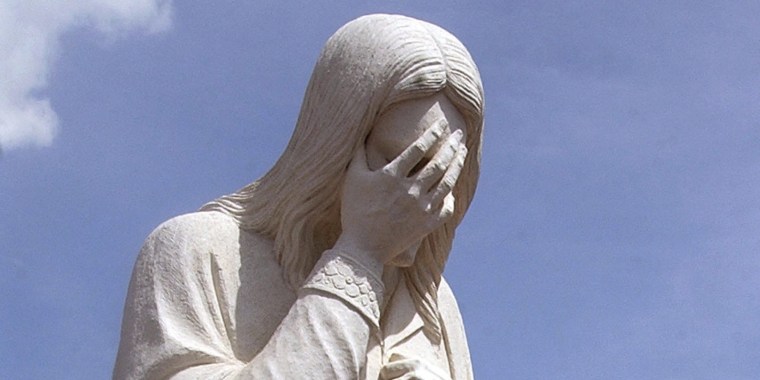
How do you think God reacts when we do wrong?
I asked this question to a group of 7-12 grade students from our student ministry last night. As always, I told them that there were no wrong answers. If the question asks what you think, and you say what you think, then you get the answer right. While they couldn’t possibly answer the question incorrectly – unless they were lying – I was hoping against hope that they wouldn’t answer, “I think God gets mad at us.”
And they didn’t say, “God gets mad at us when we mess up.” Hooray! Youth ministry win.
They gave the answer that I think a lot of people (including sometimes me) would, “I don’t think God gets mad at us when we mess up… It’s probably more like when we do something wrong and we get caught by our parents. Then they say something like, ‘We’re not mad. We’re just disappointed that you did this.‘ Like I don’t think God gets mad when we mess up, just disappointed.”
We’ve come a long way since the Sinners in the Hands of an Angry God theology. Most of us are passing on a view of God that isn’t this powerfully vengeful being watching over us who punishes us when we mess up. We’ve come a long way from our hell-fire and brimstone God who will throw someone into eternal damnation for swearing too much or having sex. We have replaced this angry, vengeful view of God with a view of God that is far more tame and human. In this view, God doesn’t want to punish us, God’s feelings just get hurt a lot. With this outlook, God is a friend who we didn’t sit with at lunch or a good parent that caught us in a lie.
At my private Christian middle school (circa 2007) we often unironically sang a song in chapel time called, Can He Still Feel the Nails. It goes like this:
Can He still feel the nails every time I fail?
Can He hear the crowd cry “crucify” again?
Am I causing Him pain, when I know I’ve got to change?
Because I just can’t bear the thought of hurting Him.
Yeah I know. A song that I think many would fairly deem manipulative.
While myself and many in my thought sphere have – in adulthood – laughed at the vast fallacy of that song and other sayings like it, I think we’re still walking around with much of the residue from those views. We’ve abandoned a view of God who hurts us because of our imperfection, and we have adopted a view of God who is hurt by our imperfection. So while we’ve been so right to run from this vengeful view of God, we may have sat down someplace that we need not stay.
This may get fairly philosophical for a bit. Roll with it.
I also just want to say, at a certain point, theology and theological arguments are in some sense broken and unhelpful because we cannot – though we may try – divorce ourselves from our different perspectives. So many people have different ideas and views on the Divine, and perhaps God is big enough to hold all of them. That said, I’ll try and make an argument that may be helpful.
So is God disappointed in us when we fail? Or when we don’t do our best?
A key underlying assumption to even asking this question is God cares about my own personal thoughts and actions. If God does not, then how could we disappoint God? We of course, cannot disappoint someone who does not care. So for the sake of argument, let’s say that God is concerned with me as an individual (my thoughts, actions, being).
Our view of God as a father or parental figure seems to really play into this view of a disappointed God. If growing up, my mom always told me, “Don’t smoke,” and she never saw or became suspicious of me smoking, she would likely expect that I don’t smoke. At that point, if she expects that I haven’t ever smoked, and she catches me smoking, she would be disappointed. Her expectations for me as her son were not met.
Our view of God as a friend can lead to this disappointed view of God too. If every week my friends and I play trivia on Tuesday night, it becomes an expectation of the friends in the group that I will go play trivia with them every Tuesday. At that point, if I bail on trivia, they could be disappointed with me. If I’ve never gone to trivia with them before, and hanging out with them every week is not an expectation, then how could they be disappointed?
Disappointment is a result of unmet expectations.
If we believe God is an omniscient, omnipotent being who is continually creating the universe, it seems unlikely to me that God would be anything less than fully aware of our past, current, and future pitfalls. Does God expect that we will be perfect or close to perfect? Does God even expect that we will give our best effort?
When I truly think about the bigness of God, quippy phrases like “Jesus expects our best” don’t hold up. It may make for a best selling keychain at LifeWay, but upon further examination, where do we even get that? An easy response would be to point me towards literally any of the commands of Jesus from the Sermon on the Mount. Good. But have you ever told someone to do something and not expected them to do it? Have you ever pointed someone in the right direction knowing it’s in their best interest, and still expected them to go their own way? I have, and I would argue that this is could be how Jesus felt.
Throughout the stories of Jesus that we have in the Bible, I have a hard time finding one that describes Jesus as disappointed. (Disclaimer: I could be wrong, and that’s the fun part about putting stuff on the internet.) However, I find a lot of times when people come to Jesus with expectations and leave disappointed. When the rich young ruler comes to Jesus explaining his goodness, expecting a warm embrace and pat on the back, Jesus asks for what he knows the man won’t give, obedience at the cost of his stuff. The man left disappointed. The religious leaders often came to Jesus with questions expecting to be affirmed as correct or to entangle Jesus, but they always left disappointed or even angry.
I would argue that disappointment is much more a human emotion that we feel towards God than the way God feels towards us. God lavishes love and grace upon us expecting nothing in return. No conditions. We don’t really get that because even in the purest forms of human connection, we expect some form of reciprocation. Even the best, most loving parents feel hurt when their children turn their backs on them. God is simply not this way.
To explain what God’s Kingdom and grace is like, Jesus tells the story of a younger brother who didn’t want to wait till his dad died to get his stuff and get on with it. This son goes to his dad and essentially says, “I want your stuff now, I don’t want to wait.” Storyteller Jesus doesn’t then say, “And the father was disappointed.” The father does what his son asks and gives him his share, and the younger son left. The father gave of his love and treasures with no conditions. While the younger son is off burning the candle at both ends, we don’t hear that the father is up all night weeping. Instead, what we see is a father who is waiting for his son to come home. When the younger son returns home, he expects his dad to be mad, or at least disappointed, but instead what he finds when he gets home is a warm embrace and a party. The only character in the story that is disappointed is the older brother, who didn’t understand the bigness of his dad’s love.
We are loved by God without conditions. Immense, pure love, way bigger and better than we love our girlfriends or our kids. Understanding that God’s immaculate love is unphased by our screw-ups or straight up screw-overs is going to help us let go of a whole lot of shame. Believing that we’ve in some way let down the Creator of the universe is a terribly shame-inducing way to live. And shame wrecks relationship. Our fear of disappointing God has for too long kept us from total communion with God and each other. When we feel convicted that we’re in the wrong, believing that God is disappointed keeps us from running home instead of pushing us to running home faster.
When we’ve taken God’s good things and twisted them for our own devices, God isn’t mad or disappointed, God just wants us home. A warm embrace and a party awaits.
 my own understanding