Tag Archives: Kingdom of God

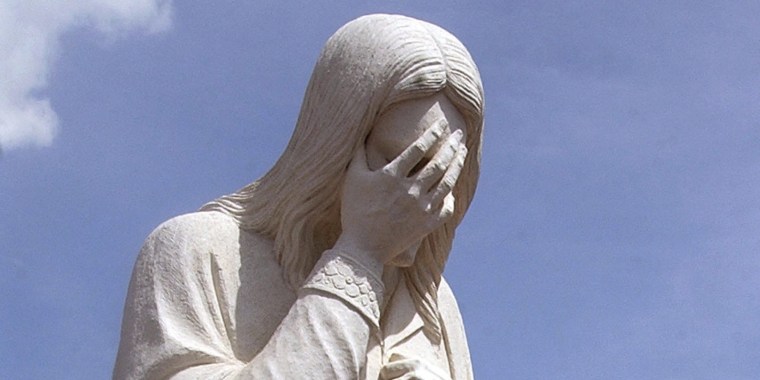
Is God not mad… just disappointed?

How do you think God reacts when we do wrong?

I asked this question to a group of 7-12 grade students from our student ministry last night. As always, I told them that there were no wrong answers. If the question asks what you think, and you say what you think, then you get the answer right. While they couldn’t possibly answer the question incorrectly – unless they were lying – I was hoping against hope that they wouldn’t answer, “I think God gets mad at us.”

And they didn’t say, “God gets mad at us when we mess up.” Hooray! Youth ministry win.

They gave the answer that I think a lot of people (including sometimes me) would, “I don’t think God gets mad at us when we mess up… It’s probably more like when we do something wrong and we get caught by our parents. Then they say something like, ‘We’re not mad. We’re just disappointed that you did this.‘ Like I don’t think God gets mad when we mess up, just disappointed.”


We’ve come a long way since the Sinners in the Hands of an Angry God theology. Most of us are passing on a view of God that isn’t this powerfully vengeful being watching over us who punishes us when we mess up. We’ve come a long way from our hell-fire and brimstone God who will throw someone into eternal damnation for swearing too much or having sex. We have replaced this angry, vengeful view of God with a view of God that is far more tame and human. In this view, God doesn’t want to punish us, God’s feelings just get hurt a lot. With this outlook, God is a friend who we didn’t sit with at lunch or a good parent that caught us in a lie.

At my private Christian middle school (circa  2007) we often unironically sang a song in chapel time called, Can He Still Feel the Nails. It goes like this:

Can He still feel the nails every time I fail?

Can He hear the crowd cry “crucify” again?

Am I causing Him pain, when I know I’ve got to change?

Because I just can’t bear the thought of hurting Him.

Yeah I know. A song that I think many would fairly deem manipulative.

While myself and many in my thought sphere have – in adulthood – laughed at the vast fallacy of that song and other sayings like it, I think we’re still walking around with much of the residue from those views. We’ve abandoned a view of God who hurts us because of our imperfection, and we have adopted a view of God who is hurt by our imperfection. So while we’ve been so right to run from this vengeful view of God, we may have sat down someplace that we need not stay.


This may get fairly philosophical for a bit. Roll with it.

I also just want to say, at a certain point, theology and theological arguments are in some sense broken and unhelpful because we cannot – though we may try – divorce ourselves from our different perspectives. So many people have different ideas and views on the Divine, and perhaps God is big enough to hold all of them. That said, I’ll try and make an argument that may be helpful.

So is God disappointed in us when we fail? Or when we don’t do our best?

A key underlying assumption to even asking this question is God cares about my own personal thoughts and actions. If God does not, then how could we disappoint God? We of course, cannot disappoint someone who does not care. So for the sake of argument, let’s say that God is concerned with me as an individual (my thoughts, actions, being).

Our view of God as a father or parental figure seems to really play into this view of a disappointed God. If growing up, my mom always told me, “Don’t smoke,” and she never saw or became suspicious of me smoking, she would likely expect that I don’t smoke. At that point, if she expects that I haven’t ever smoked, and she catches me smoking, she would be disappointed. Her expectations for me as her son were not met.

Our view of God as a friend can lead to this disappointed view of God too. If every week my friends and I play trivia on Tuesday night, it becomes an expectation of the friends in the group that I will go play trivia with them every Tuesday. At that point, if I bail on trivia, they could be disappointed with me. If I’ve never gone to trivia with them before, and hanging out with them every week is not an expectation, then how could they be disappointed?

Disappointment is a result of unmet expectations.

If we believe God is an omniscient, omnipotent being who is continually creating the universe, it seems unlikely to me that God would be anything less than fully aware of our past, current, and future pitfalls. Does God expect that we will be perfect or close to perfect? Does God even expect that we will give our best effort?

When I truly think about the bigness of God, quippy phrases like “Jesus expects our best” don’t hold up. It may make for a best selling keychain at LifeWay, but upon further examination, where do we even get that? An easy response would be to point me towards literally any of the commands of Jesus from the Sermon on the Mount. Good. But have you ever told someone to do something and not expected them to do it? Have you ever pointed someone in the right direction knowing it’s in their best interest, and still expected them to go their own way? I have, and I would argue that this is could be how Jesus felt.

Throughout the stories of Jesus that we have in the Bible, I have a hard time finding one that describes Jesus as disappointed. (Disclaimer: I could be wrong, and that’s the fun part about putting stuff on the internet.) However, I find a lot of times when people come to Jesus with expectations and leave disappointed. When the rich young ruler comes to Jesus explaining his goodness, expecting a warm embrace and pat on the back, Jesus asks for what he knows the man won’t give, obedience at the cost of his stuff. The man left disappointed. The religious leaders often came to Jesus with questions expecting to be affirmed as correct or to entangle Jesus, but they always left disappointed or even angry.

I would argue that disappointment is much more a human emotion that we feel towards God than the way God feels towards us. God lavishes love and grace upon us expecting nothing in return. No conditions. We don’t really get that because even in the purest forms of human connection, we expect some form of reciprocation. Even the best, most loving parents feel hurt when their children turn their backs on them. God is simply not this way.


To explain what God’s Kingdom and grace is like, Jesus tells the story of a younger brother who didn’t want to wait till his dad died to get his stuff and get on with it. This son goes to his dad and essentially says, “I want your stuff now, I don’t want to wait.” Storyteller Jesus doesn’t then say, “And the father was disappointed.” The father does what his son asks and gives him his share, and the younger son left. The father gave of his love and treasures with no conditions. While the younger son is off burning the candle at both ends, we don’t hear that the father is up all night weeping. Instead, what we see is a father who is waiting for his son to come home. When the younger son returns home, he expects his dad to be mad, or at least disappointed, but instead what he finds when he gets home is a warm embrace and a party. The only character in the story that is disappointed is the older brother, who didn’t understand the bigness of his dad’s love.

We are loved by God without conditions. Immense, pure love, way bigger and better than we love our girlfriends or our kids. Understanding that God’s immaculate love is unphased by our screw-ups or straight up screw-overs is going to help us let go of a whole lot of shame. Believing that we’ve in some way let down the Creator of the universe is a terribly shame-inducing way to live. And shame wrecks relationship. Our fear of disappointing God has for too long kept us from total communion with God and each other. When we feel convicted that we’re in the wrong, believing that God is disappointed keeps us from running home instead of pushing us to running home faster.

When we’ve taken God’s good things and twisted them for our own devices, God isn’t mad or disappointed, God just wants us home. A warm embrace and a party awaits.

The Pledge and Playing it Safe

Before I start, I just want to say that writing this is not easy. I’m well aware that many friends, family, or fellow Christians may disagree with me, but I also know that I am not always called to be agreeable. And I write this because I believe it to be truthful in my life. If I do end up posting what I write, I pray that God will do what He wills with it. God always seems to do that.

A teacher in school once told our class, “Never begin a speech or a paper with a definition.” BUT these teachers always said, there’s exceptions to every rule, and when we were a big-time author we could break the rules. I’m not a big-time author, but I do have my own, free-to-use blog that my mom may read, so I’m just going to break the rules anyways…

Merriam Webster defines allegiance as “devotion or loyalty to a person, group, or cause.” Now growing up in the U.S., the first thing I think of relating to allegiance is the “Pledge of Allegiance.” We all know it by heart. We grew up reciting it every morning in our schools. In elementary school, does anyone actually know what they’re saying? I remember thinking there was a word in the pledge that was “witchit.” I did not know what it meant, but we said it every day, so it had to mean something. As it turns out, that is actually two words “which it.” The whole thing goes like this:

I pledge allegiance to the Flag of the United States of America, and to the Republic for which it stands, one Nation under God, indivisible, with liberty and justice for all.

I don’t know why it seemed so long in school. Maybe because it was the morning? I am not much of a morning person. Or maybe it was because time seems to pass faster now? Who knows. Anyway, that’s what we said, every single day. Then when I was old enough to go to Church Camp, we said it there every morning as we raised the flag. This just seemed to me like part of life in this country, and I didn’t think another thing about it.

Well at least I didn’t think about it for a while. I graduated a year and a half ago from a school named after a preacher of the American Restoration movement, David Lipscomb. In learning about his life and his work, it struck me how he was unwavering in his stance that his citizenship was in the Kingdom of God, not in this country. Lipscomb did not take part in elections, and he also was a strong voice for nonviolence. Growing up in Christian circles, I had never heard this idea. Perhaps I thought that a good American was a Christian, and a good Christian was a “patriotic” person. For many older people with more life experience than my generation, some may view this country as a shining light of freedom in a world of darkness.

I have a hard time rectifying this vision of the U.S. as a beacon of hope with God’s vision of the Church. In Matthew 5, Jesus is preaching to the people.

“You are the light of the world. A town built on a hill cannot be hidden. Neither do people light a lamp and put it under a bowl. Instead they put it on its stand, and it gives light to everyone in the house. In the same way, let your light shine before others, that they may see your good deeds and glorify your Father in heaven.”  -Matthew 5:14-16

This tells me that God’s light of the world is His people: the Church. God is calling His people to do good deeds to bring glory to the Father. We are God’s people. Many of us know of other Christians in other countries, and they are no less part of the Kingdom of God than anyone who lives in this country. So we, God’s people, are to be a light, I get that. What else is required of us? Jesus goes on his sermon, and he teaches on taking care of the poor, prayer, fasting, and finding our treasures in heaven. Then he says this:

“No one can serve two masters. Either you will hate the one and love the other, or you will be devoted to the one and despise the other. You cannot serve both God and money.”  -Matthew 6:24

This is a painful teaching. Of course Jesus is talking about money here, but He is also talking about many other things that may become a master of our life. This teaching refers to power, sex, relationships, sports, and yes, the powers and authorities of the world. Occasionally, our country and God may have similar interests, but that is certainly not something that is consistent. God wants all of us, 100%, to be devoted to Him. Jesus’ message does not really attract those who only want a hobby.

This complete devotion that Jesus is requiring brings me back to the idea of allegiance. If we are completely devoted to following Christ, then our allegiance belongs to the Kingdom of God. I don’t believe myself capable of having multiple allegiances. At some point, we will make decisions that show where our devotion is, and I do not feel called to pledge my allegiance to a flag or a country. Believe me, this is not something that I really want to share on the internet. This idea has been banging around in my head for a few years now. I can no longer pledge allegiance to the flag and our country with a clean conscience.

This is not something I have decided based on the current political landscape or the many athletes who have taken a knee during the national anthem.  Throughout Scripture, God is calling upon His people to serve Him only.  All kids raised in church have to memorize the 10 Commandments.  Commandment #1: “You shall have no other gods before me.”  Commandment #2: “You shall not make for yourself and image in the form of anything in heaven above or on the earth beneath or in the waters below. You shall not bow down to them or worship them, for I, the Lord your God am a jealous God.”  So maybe you don’t see standing, placing your hand over your heart, and pledging your devotion to a man-made object and human construct as idol worship?  OK, but its at least similar, right?

Then I look at a story from the book of Daniel about these three guys Shadrach, Meshach, and Abednago.  Here these guys are living in a foreign empire and the king has a giant golden statue of himself made (a sign of empirical supremacy).  He decrees that everyone must bow down to this statue or be thrown into a furnace and burned alive.  So the time comes and everyone is gathered together in one place.  The instruments are played and everyone starts to bow, everyone except these three guys.  Can you imagine the looks even from other God-fearing people?  Can you imagine the whispering from their friends?  “Just bow and get it over with! It doesn’t mean anything! Just play it safe and do what you’ve gotta do!

Maybe you’ve heard, “Just play it safe and do what you’ve gotta do” before.  Maybe it was something at work that you just had to do to keep your job.  Maybe it was going along with the racist joking of a group of people because you were in the minority and didn’t want to be “that guy.”  There’s many times in our lives where we feel this pressure to play it safe and conform, and we are even advised by our friends and family to do so!  But I have been trying to think of a time where Jesus advised playing it safe, and I’m struggling to think of a time.

So anyways, the King has these three guys brought in and, to paraphrase, says, “I’m dead serious, I will throw you into the furnace if you don’t start playing along.”  Shadrach, Meshach, and Abednago, go on and tell this King that they believe God can deliver them from any harm, OH AND ALSO, and here’s the kicker for me, they say “But even if he does not, we want you to know, Your Majesty, that we will not serve your gods or worship the image of gold that you have set up.” *mic drop*

So now they’ve really done it!  The King is ticked!  He has the furnace made 7 times hotter than normal, ties them up and tosses them in there.  Then he looks in and sees 4 people in there, even though he only put 3 in… and the new one “looks like a son of the gods.”  They aren’t getting burnt up and their bindings are gone.  So the King has them brought out, and then goes on to praise God and decrees that “the people of any nation or language who say anything against the God of Shadrach, Meshach, and Abednago be cut into pieces and their houses be turned into piles of rubble, for no other god can save in this way.”

Not only did Shadrach, Meshach, and Abednago stand up for their convictions, but God used that to change the heart of the most powerful person in the world.  When we give a little, God multiplies it!

So all that to say, we are not called to play it safe or be agreeable.  We are not called to give our devotion to any earthly government or symbol of that government.  We are called to give 100% of our allegiance to the Almighty God, the only God who can save.

And I’ve had this post sitting in my drafts for 8 months, playing it safe, but today God gave me courage.  And let’s be honest here, I don’t have a wide readership.  And I stand at no risk to face imprisonment or any formal punishment because our country doesn’t do that, so how big of a risk am I really taking here?  But we can only be faithful with the platforms that we have been given.  We aren’t given the luxury of choosing what to care about. God tends to put stuff on our heart that won’t go away until we do something about it.

Also, I do not tell you this to start a movement. I simply tell you this because I had to. Maybe what I have written will make you think, and maybe you’ll read this and disregard it completely, that’s fine. I appreciate you hanging with me till the end.

Reflecting Praise

Sometimes, people say good things about me.  I’m sure people say good things about you too.  Isn’t it nice when people say good things about us?  Doesn’t it make us feel good about ourselves?  Well it does sometimes, anyways.  Other times, doesn’t it make us feel shameful?  I know this is part of my story.  Why does someone saying good things about me make me feel shameful?  Because I know myself.  I know I’m not good.  Maybe you’ve felt similarly?

For the longest time, when someone would give me a genuine compliment about something they saw me do or heard me say, I would say, “Thanks,” but immediately think, “If they knew about that one thing that I’ve done or do, there’s no way they would say good things about me.”  We’ve probably all felt that way on some level before.  I know as someone who works in a local church, sometimes I feel pressure to look like I’m loving and flourishing at the whole following Jesus thing, even when I know I’m not.  This feeling of “if they only knew ‘x,’ they wouldn’t love me,” is called shame, and yeah, shame is not from God.

See, we all have issues.  Each and every person on earth has that sin or sins that tempt us, that call out to us, and that we have given in to before.  And yes, by the grace of God we have been set free from the bondage of sin!  But if you’re like me, sometimes you might choose the temptation of the sin that is familiar over walking freely with God.  And this happens, and no its not the right decision or action, but unfortunately, it happens.

But here’s the kicker, if I were perfect, I might start reading my own press clippings.  I might start thinking that things are going well because I made good things happen.  I may start thinking that when people compliment me, that they are doing as they should because I’m pretty awesome.  And if we’re honest, there have been times where we’ve had this attitude as well.

“OK, Michael.  Now I’m confused, because first you said that shame and thinking that we’re bad is not from God, and now you’re saying that we’re not supposed to think that we’re super amazing.  So like, what are we supposed to think?”

That’s a fair question!  So here’s the thing: Any compliments or praise that we receive for the way we live is a compliment or praise that belongs to God alone!

Let’s face it, God works through us, and we are FAR from perfect!  I would go as far as to say that God exclusively works through imperfect people.  It doesn’t take much time reading the Bible to see that He used people with some serious issues to advance the Kingdom of God on earth.  God used Jacob, a cheater and liar, to be the forefather of His people.  He used David, a scheming adulterer, to unite His people.  And God used Saul of Tarsus, killer of Christians, to spread the good news all over the known world.

Here on earth, we are God’s instruments in the symphony of His Kingdom.  When someone does something impressive with a violin, we don’t go up after the show and tell the violin that it did a great job.  The good things that others see in us are merely a reflection of our Heavenly Father, who has given us great gifts.  “Whatever is good and perfect is a gift coming down for us from God our Father, who created all the lights in the heavens.  He never changes or casts a shifting shadow.” (James 1:17)

God gives us words to say and things to do to reflect His glory on earth.  So when we receive praise, let us pass that on to God who uses us in ways that we could never choose for ourselves.  For God’s is the Kingdom, and the Power, and the Glory forever and ever, Amen.


Identity Crisis

Looking back over my 22 years on earth, I see a lot of different things that I have done.  I also see the different people that I have been along the way.  Maybe that doesn’t make sense to you.  Let me explain…

Throughout my life, if you asked me to describe myself, my answers would be different based on what I was into in that moment, or who I was trying to be.  I remember in elementary school, I thought I was THE smartest kid in the whole school.  So, in order to prove my intellectual superiority, I entered into the 3rd grade spelling bee.  I studied a little, my mom quizzed me and whatnot, so I felt very confident going in.  Obviously, I was a little nervous, there was going to be a lot of people there.

*I take the stage behind the podium for the first word.*

“Michael, your word is museum.”

“Ok… m-u-s-u-e-m.”

“That’s incorrect.  The correct spelling is m-u-s-e-u-m.”

*I start crying as I walk to my mom.*

Well, that was disappointing.  Later one of my teachers said, I bet you’ll never forget how to spell that word, will you?  She was right, I didn’t.  Why do teachers have to be right all of the time?  They’re like moms, moms are always right.

So I was determined to take my rightful place among the top spellers in the land.  I entered into the 4th grade spelling bee.  I studied exponentially more.  My mom quizzed me a whole bunch.  I was ready.  I felt like Rocky Balboa before his fight with Ivan Drago (Rocky IV).  I glided through the first several rounds with ease.  This was my year, I just new it.  And it was down to me and my arch nemesis, Bianca.  This wasn’t the first time we had squared off, she was also impressive when it came to multiplication tables.

*I step to the podium*

“Michael, your word is collage.”

“uhh… (palms are sweaty, knees weak, arms heavy) c-o-l-a-u-g-e.”

“That is incorrect.  The correct spelling is c-o-l-l-a-g-e.”

*I step back.  Bianca steps to the podium.*

“Bianca, if you spell this correctly, you will win the spelling bee.  Your word is banana

“b-a-n-a-n-a”

*My heart burns with rage.*

I know what you’re thinking, totally unfair, right?  SHE SHOULD HAVE HAD TO SPELL COLLAGE!!!  I had been snubbed, yet again, by my imperfections and a broken system.  This was unjust to say the least.  To make it worse, my little brother Joel won the 2nd grade spelling bee in a landslide, then the 3rd grade, then the 4th.

If I actually look deeper at why I was so upset, I realize that these were not simple losses of spelling bees, they were losses of my identity.

Throughout middle school and high school, I tried to find my identity in other things.  I tried to find my identity in football.  The thing about that was, I was no good at football.  And in high school, I was injured most of the time.  I also tried to find my identity in being the funny guy.  You know this type of person, they have to be the funniest person in the room at all times.  But someone always got more laughs than me.

In college, I tried to find my identity in being all Christian author-y.  I read Donald Miller’s Blue Like Jazz and wanted to be just like him.  I started a blog – this blog – to show my skills as a writer.  I read Shane Claiborne’s The Irresistible Revolution, and I wanted to be just like him.  I started wearing bandanas to show how pacifistic I was.  I thought that being a pacifist was the coolest.

See, I was so busy trying to be all of these different things, that somewhere along the way, I forgot to be me.

One of my favorite quotes from the recent Olympic season is from Simone Biles (I know, you were expecting America’s new hero and role model, Ryan Lochte. /s).  In an interview, Simone Biles, darling of the U.S.A., made the statement, “I’m not the next Usain Bolt or Michael Phelps, I’m the first Simone Biles.”  It would be easy for her to feel some need to get as many medals as Phelps or Bolt, or to accept that she is another exceptional Olympic athlete who should be mentioned in the same sentence as those two icons.  Biles is a terrific athlete, and there has never been another like her.  Despite all of that, she is focused on being the best Simone Biles that she can be.

That is the point isn’t it!?  God has made us all unique and different!

We do ourselves and the Kingdom of God a disservice when we place our identity in anything other than being children of God existing for the redemption of the world.

Just as a body, though one, has many parts, but all its parts form one body, so it is with Christ.    1 Corinthians 12:12

We are all differently gifted and blessed by God to serve in ways that only we can!  We are members of the body of Christ, created for a specific purpose, and together, God will do powerful things.


Peace and Blessings,

-Michael