Mark 10:37-45 – Bartimaeus – The Way of the Cross

Today, we’re wrapping up our series reading through this middle section of Mark. In this series, Jesus is getting his closest disciples ready to head to Jerusalem. He’s now told them on three separate occasions that things aren’t going to go like they might think. They’re not heading to a coronation, they’re heading to a crucifixion. Jesus has told them more and more plainly what’s going to happen. The religious leaders will reject him, he’ll be arrested, beaten, and die a painful death on the cross.

And throughout the chapters in which Jesus is telling his disciples this, we see the same theme popping up over and over again: the first shall be last. Jesus didn’t come to be served but to serve. If you want to be greatest, be the least. Care for people who can’t do anything for you. Sell what you have and give it to the poor. If you want to save your life, you have to lose it.

Today, we’ll see yet another example of the great reversal of the Kingdom of God and talk about what it means for us.
__________________________________________________________________

Mark 10:46-52

46 Then they came to Jericho. As Jesus and his disciples, together with a large crowd, were leaving the city, a blind man, Bartimaeus (which means “son of Timaeus”), was sitting by the roadside begging. 47 When he heard that it was Jesus of Nazareth, he began to shout, “Jesus, Son of David, have mercy on me!”
48 Many rebuked him and told him to be quiet, but he shouted all the more, “Son of David, have mercy on me!”
49 Jesus stopped and said, “Call him.”
So they called to the blind man, “Cheer up! On your feet! He’s calling you.” 50 Throwing his cloak aside, he jumped to his feet and came to Jesus.
51 “What do you want me to do for you?” Jesus asked him.
The blind man said, “Rabbi, I want to see.”
52 “Go,” said Jesus, “your faith has healed you.” Immediately he received his sight and followed Jesus along the road.

Let’s imagine this scene for a moment, Jesus and his disciples are leaving the city of Jericho, they’re passing through the city gates. There’s a crowd around them, people excited to be following this Messianic figure to Jerusalem where they believe he’ll be crowned king. We know better, but they didn’t. And so this King Jesus is walking down the road with a huge crowd following him around and off to the side, there’s a blind man who starts hollering out to Jesus: “Son of David! Have mercy on me!”

Imagine you’re part of this large group. You have to think: There’s no chance we’re stopping all these people to talk with a beggar on the side of the road. Parade’s don’t stop because somebody in the crowd asks them to. You’ve seen the motorcade’s that our politicians role through the streets in. Those are not stopping.

But somehow in the midst of the crowd and the chatter, despite the people who see the beggar and are trying to shut him up, Jesus hears this beggar who’s calling out to him “Son of David! Have mercy on me!”

And Jesus says, “call him over here.” Jesus is willing to stop this whole thing to have a conversation with this beggar. Not a person who can get him free tickets or a promotion, just a blind beggar. And Jesus’ question is: “What do you want me to do for you?”

If you were reading this in Mark, this question would be familiar because just earlier in this same chapter, this is Jesus’ response to his disciples, James and John. Last week, we talked about how James and John came to Jesus and said, “Jesus, give us whatever we ask,” which is a bold way to bring a request to someone. Jesus responds with this same question: “What do you want me to do for you?” They asked for positions of honor in the new Kingdom that was coming. Jesus doesn’t honor their request to be placed at his right and his left, saying that’s not his request to grant. He goes on to explain to his disciples later that the true measure of greatness is not your position, it’s who you serve. Jesus hasn’t come to serve, but to be served.

And so Jesus’ disciples are hoping for places of honor in his Kingdom, and strangely enough, this beggar’s name means “son of honor.” “Timaeus,” his dad’s name means “honor” which means Bartimaeus means “son of honor.” We don’t always get the names of people in the Bible who only pop up one time, so when we do see it, it’s good for us to investigate that name. Why, in this case, did Mark choose to include this blind beggar’s name, Bartimaeus?

I think Mark included his name here because this is a story about honor. We have Bartimaeus on the side of the road calling out for mercy. His name means “son of honor,” and yet I’m sure he is used to being treated with dishonor. In fact, in the story we see this play out. He calls out to Jesus for mercy and everyone tells him to knock it off.

But Jesus breaks this trend of dishonor and stops, having his disciples call Bartimaeus over to him. He honors Bartimaeus by offering him His presence and wanting to hear his request. Jesus honors the person in the story who is dishonored.

And instead of just assuming what Bartimaeus might want or need, Jesus honors Bartimaeus by giving him agency, asking Bartimaeus, “What do you want me to do for you?”

I think we’d be missing out on something really important here if we didn’t mention the extreme irony of this situation. Though Bartimaeus is blind, he is the one who sees the need for his relationship to Jesus and places himself in the right posture towards Jesus as someone who needs mercy. He tells Jesus, “I want to see,” but Bartimaeus has identified Jesus better than those who have already been able to see Jesus.

Now let’s compare and contrast this story to the story we covered last week with James and John asking for places of honor in the Kingdom. We see Jesus initially respond the same way to both, asking “what do you want me to do for you?” I think a simple and quick thing we can takeaway from this is that Jesus wants to hear our requests, our real requests, not just ones like “can you make me a better husband?” but all of our requests because when we are honest with someone and tell them honestly about our wants, our hopes and dreams, we grow closer to that person.

Jesus wants to hear our requests.

Jesus’ question is the same, but he receives two very different requests from James & John and Bartimaeus. James & John are asking to be honored. Bartimaeus is asking for sight. James & John are asking for status and esteem. Bartimaeus is simply asking for mercy. And Jesus honors Bartimaeus’ request because God is merciful.

Jesus honors the request of Bartimaeus, a person who likely doesn’t receive honor as he sits by the road near the city gates, but this shouldn’t surprise us because this is the gospel. This is the message that we have been hearing Jesus teach his disciples for the last several weeks: the first shall be last.  If you want to be the greatest, become the least. If you want to find life, give up the life you have. Take care of those who can never pay you back. Welcome to the new kingdom, it’s backwards from the world we often live in.

And so I think a great way for us to reflect on this passage and on this series as we conclude it today, is to ask ourselves a couple questions. The first being, do we honor who Jesus honors? In this story, Jesus honors the blind beggar Bartimaeus by giving him his time, asking how he can help, and responding mercifully.

Who are we willing to connect with even when it is inconvenient? Who are we seeking out input from? Who are we extending mercy to? If the answer to these questions is only people who look like us, people who are of similar status as us, and people who can offer us the same kindness in return, I don’t think we’re doing it right. I don’t think we’re honoring who Jesus honors.

Jesus uplifted this blind man Bartimaeus even though no one would’ve batted an eye if he hadn’t. Jesus harped on the importance of showing kindness to children, even though they were often overlooked and dismissed. Jesus honored the value of all people as he headed to Jerusalem knowing he would die on the cross.  

Are we willing to do the same? Are we willing to care for the folks we pass on the street? Are we willing to be inconvenienced on someone’s behalf knowing they’ll never be able to repay that favor? Jesus says this is the way to life. I want to encourage you this morning, take up this cross and experience the good life that Jesus is calling us into. And please encourage me to do the same.

And finally, how do we answer Jesus’ question, “What do you want me to do for you?” James and John wanted honor, Bartimaeus wanted mercy. What do you want from Jesus? Be honest, God knows your heart. What do you want Jesus to do for you?

Maybe this morning, you need mercy. Maybe you need good news. Maybe you just need a break. Jesus welcomes you with all of your needs and requests.

Each week as we go to the Table, we remember that Jesus has already given us what we most needed: new life. We drink from the cup and eat this bread and remember that Jesus has given us the best gift, himself. We have already received this mercy that Bartimaeus was calling out for. Because of that, let’s remember to offer that same mercy, that same good news to those around us this morning and this week.

October 6th, 2024

Watch here: https://youtu.be/vQv5_4dtMP4?si=ns3w1iIhRBSUYsjr&t=1700
Mark 9:30-37 – The Way of the Cross

Last week, Josh preached through the first week of our new series, The Way of the Cross. During this series, we’re going to be couched right in the middle of Mark. By this point in Mark’s Gospel, Jesus has amassed this huge following. It’s hard to get away from the crowds. Jesus is officially a big deal. He’s cast out demons, he’s healed the sick, and he’s raised people from the dead. And even while doing all of that, He’s still found a way to make some people mad, specifically the religious leaders because He does things a little differently. He’s broken some traditions because in doing so, He was able to care for people better.

I think it’s good for us to think about these intimate teaching moments between Jesus and his disciples as a response from Jesus. A response to the wildfire of notoriety and intrigue that Jesus’ ministry has caused. In chapter 8, we see Peter rightly identify Jesus as the Messiah, and now we are seeing Jesus begin to teach his disciples about what that actually means. It’s not all crowds and fanfare. We’re heading to a crucifixion, not a coronation.

Last week, we read how Jesus plainly tells his disciples what’s going to happen. The Son of Man will suffer and be rejected by the religious establishment. He’ll be killed, and in three days, he will rise again. And we saw that the disciples didn’t get it, namely Peter, who pulls Jesus aside and rebukes him before Jesus tells him, “Get behind me, Satan.”

Jesus teaches his disciples what it truly means to follow Him:

“Whoever wants to be my disciple must deny themselves and take up their cross and follow me. For whoever wants to save their life will lose it, but whoever loses their life for me and for the gospel will save it.”

Today, we see Jesus once again teaching his disciples. This is Mark chapter 9, verses 30-37:

30 They left that place and passed through Galilee. Jesus did not want anyone to know where they were, 31 because he was teaching his disciples. He said to them, “The Son of Man is going to be delivered into the hands of men. They will kill him, and after three days he will rise.” 32 But they did not understand what he meant and were afraid to ask him about it.
33 They came to Capernaum. When he was in the house, he asked them, “What were you arguing about on the road?” 34 But they kept quiet because on the way they had argued about who was the greatest.
35 Sitting down, Jesus called the Twelve and said, “Anyone who wants to be first must be the very last, and the servant of all.”
36 He took a little child whom he placed among them. Taking the child in his arms, he said to them, 37 “Whoever welcomes one of these little children in my name welcomes me; and whoever welcomes me does not welcome me but the one who sent me.”

Here we see in a couple different scenes, Jesus trying to get the message to his disciples that this is not about being the greatest, it’s about making yourself the least. It’s not about getting it all, its about giving it all.

To me, this is a story about Expectations.

Between the miracles, the crowds, and what they might expect from the Messiah, Jesus knows that these disciples’ expectations may be way out of whack. Sure, these disciples started following this guy Jesus, becoming friends with Jesus when He was this up-and-coming teacher, but things had changed.

These disciples started walking around with Jesus when He was just a teacher from Nazareth in the eyes of many, but things were different now. They weren’t just filling up houses anymore and hanging out in the synagogue but now they were drawing crowds big enough fill up a venue the size of Ascend Amphitheater downtown. Just a couple weeks before this moment between Jesus and his disciples, Jesus was just out teaching on a hill and 5,000 people showed up.

This may not connect for you, but this is true for a lot of folks and myself if I’m not careful: accolades can be intoxicating. Being the person drawing a crowd or simply being in proximity to the person drawing a crowd can be a point of pride.

And so these disciples – who were absolute nobodies before Jesus, just regular joes, fisherman, tax collectors, protesting rebels – now were best friends with the Messiah, which to them meant they were going to be best friends with the king. They had basically quit their jobs and left home to follow a teacher, but now they were going to be in charge. They might start to believe that because of this meteoric rise, they were going to have land and access and wealth.

Their expectations for what was coming needed adjusting. As a parent, I’m learning how important it is to manage expectations. There’s certain things that if I say them out loud I know that I better follow through with it. Like if I say we’re going to a grandparents house, I better not say it too far in advance, and it better actually happen because Wesley’s already excited about it. Same thing with donuts. If donuts are mentioned, donuts better be had. Every Friday, Wesley and I go to get donuts at Donut Palace, and so he’s begun to expect that when it’s just us two in the car, that’s what’s going to happen. When I picked him up from preschool on Thursday, his first sentence was: “Daddy, Donuts!”

Jesus is taking this time with his disciples to adjust their expectations, to orient them in the right direction, to let them know what’s coming. He’s already told them once, and it didn’t take. I think perhaps their expectations for what was to come were so different than what Jesus was telling them that they literally couldn’t understand what He was saying. Maybe you’ve experienced something so disorienting that you literally couldn’t understand what the person was telling you.

Jesus is saying, you want to follow me and that’s great, but here’s what that really means. It’s not going to be smooth sailing. People aren’t always going to be seeing me this way. They’re going to reject me and kill me because the Kingdom we’re building isn’t like the kingdoms you’re familiar with. Once again, they didn’t get it.

The text tells us: “they did not understand what He meant and they were afraid to ask him about it.” Of everything in this piece of Scripture, I think this may be the verse that I find most relevant to me. I don’t know if you’re like this, but it’s hard for me sometimes to admit that I don’t know what I’m doing and that I need help, even though needing help is a totally normal thing to experience.

I remember when my older brother was on the high school football team, and we’d go to all his games on Fridays. We’d drive all over the mid-state during football season. One time the game was at Marshall County High School in Lewisburg, but when we got there, the football field wasn’t at the high school, it was like a mile or two away or something. So we got to the high school and there was no football field. And there was no smartphones, and we were in the boonies so there wasn’t really cell phone service either. We drove around for like 30 minutes looking for the football field and couldn’t find it. We were lost. But my dad didn’t want to ask for directions… I don’t say this to shame my dad because I also have an aversion to asking strangers for help, and I would’ve done the same thing, but when I’m driving now I have a smartphone equipped with Google and a GPS and everywhere has cell service. Of course, eventually, my dad broke down and we asked somebody at a McDonalds how to get to the football field, and we got there in 5 minutes, but we missed the whole first quarter driving around aimlessly.

When I was growing up, I didn’t think it was ok to ask questions about my faith. If something didn’t make sense or I was having doubts, I didn’t feel like it was ok to say that out loud. But it’s so important to ask questions and for us to ask questions together. I’m thankful to be a part of a church community that I think believes its ok to ask questions even if we don’t always have answers.

So these disciples don’t get it, but they don’t ask any questions. And instead of asking questions as they walk along the road, they argue about which among them is the greatest, proving again that their expectations for how this is all going to go down are way off. They don’t understand. They’ve been told twice now by Jesus that we’re heading to rejection not acclamation. We’re heading to a crucifixion not a coronation. But their expectations are so far off that what Jesus is saying isn’t making sense to them.

They don’t tell Jesus what they were arguing about on the road, but I’m sure he knows because he sits them down and tells them that if they want to be great, they need to make themselves the least. If they want to be first, they need to be the very last, and he illustrates this point by picking up a small child in his arms. Jesus says, “Whoever welcomes one of these little children in my name welcomes me; and whoever welcomes me does not welcome me but the one who sent me.”

You want to be great? Then welcome a child. Help someone who can’t help you back. Look after someone who can’t look after themselves.

Time after time after time, Jesus teaches his disciples to do the opposite of what the world expects: You’ve heard it said an eye for an eye, but I’m telling you when someone strikes you on one cheek, turn the other to them also. When someone asks for your coat, give your shirt to them also. When someone wrongs you, don’t return that wrong, go to them and work it out. If you want to be first, be last.

Now, we know who is first. The person who, despite being God in human flesh, became the servant of all. Because Jesus put himself last, God elevated him to the highest place. At his name, every knee will bow and every tongue will confess that Jesus is Lord. Because He put himself last.

Jesus knew he was heading to a crucifixion, not a coronation, and he went through with it anyway. And now, Jesus is inviting us to do the same. Serve others. And not just others who can pay you back, especially those who can’t pay you back. Take care of people who can’t take care of themselves. If we want to be a great church, we have to encourage each other to walk deeper and deeper into caring for our most vulnerable neighbors. To become great, we have to make ourselves least just like Jesus did.

Let’s be the greatest church. Let’s do that by actually doing the things that Jesus calls us to do. These are not pie-in-the-sky wishful thinking suggestions, Jesus is revealing to us a new way to live, a better way to live.


When we go to the Table each week, we remember Jesus, who invites us all to sit at his Table. Who are we inviting to our tables? Whose voices matter to us? For whom do we show concern? If we don’t answer these questions the way Jesus answers these questions, we’re missing the point just like Jesus’ disciples. If we only show kindness to those who can return the favor, if we only invite people to our tables who look like us, talk like us, and think like us, we’re missing the point. When we welcome the least, we welcome Jesus to our tables.

As we commune together this morning with God and each other, let our time together inspire us to embrace the teachings of Jesus in new ways, that we will go into our world more reflective of Jesus’ love than we were before.

September 15th, 2024

Watch here: https://youtu.be/9WvmZw6D4ns?si=DgrNscP35ptZ6uA1&t=1253

A New Heart – Ezekiel Pt. 4 (Dry Bones)

We’re getting close to the end of our Ezekiel series with just one Sunday left after today. I don’t know about you, but I’ve really enjoyed it. The book of Ezekiel was so unfamiliar to me, but God has been showing me some really cool stuff, and I hope you’re getting some of that too. Today, we’re going to be reading the most well-known section of Ezekiel together, and I’m excited to get into it with you.

__________________________________________________________

Ez. 37:1-14

1 The hand of the Lord was on me, and he brought me out by the Spirit of the Lord and set me in the middle of a valley; it was full of bones. He led me back and forth among them, and I saw a great many bones on the floor of the valley, bones that were very dry. He asked me, “Son of man, can these bones live?”
I said, “Sovereign Lord, you alone know.”
Then he said to me, “Prophesy to these bones and say to them, ‘Dry bones, hear the word of the Lord! This is what the Sovereign Lord says to these bones: I will make breath[a] enter you, and you will come to life. I will attach tendons to you and make flesh come upon you and cover you with skin; I will put breath in you, and you will come to life. Then you will know that I am the Lord.’”
So I prophesied as I was commanded. And as I was prophesying, there was a noise, a rattling sound, and the bones came together, bone to bone. I looked, and tendons and flesh appeared on them and skin covered them, but there was no breath in them.
Then he said to me, “Prophesy to the breath; prophesy, son of man, and say to it, ‘This is what the Sovereign Lord says: Come, breath, from the four winds and breathe into these slain, that they may live.’” 10 So I prophesied as he commanded me, and breath entered them; they came to life and stood up on their feet—a vast army.
11 Then he said to me: “Son of man, these bones are the people of Israel. They say, ‘Our bones are dried up and our hope is gone; we are cut off.’ 12 Therefore prophesy and say to them: ‘This is what the Sovereign Lord says: My people, I am going to open your graves and bring you up from them; I will bring you back to the land of Israel. 13 Then you, my people, will know that I am the Lord, when I open your graves and bring you up from them. 14 I will put my Spirit in you and you will live, and I will settle you in your own land. Then you will know that I the Lord have spoken, and I have done it, declares the Lord.’”

Once again Ezekiel tells the story of a vision he has received from God. And this time, there’s no creatures. There’s no wheels. There’s no wall to go through. Instead, God takes Ezekiel to the valley of dry bones. Sort of spooky right? You may be thinking you missed an awesome way you could decorate your front yard for trick-or-treaters, but there’s always next year. God takes Ezekiel to the valley of dry bones and takes him back and forth among the bones on the ground.

It’s kind of a hopeless, lifeless, post-apocalyptic picture. God tells Ezekiel that these bones represent the people of Israel. Not ones who are physically dead though. These bones represent people who are physically alive, but they are dead in a sense. They’re in exile. Cut off from the one relationship that gives them true life because of their disobedience, their pride, their violence, their idolatry.

You see, this is a story about God’s Covenant.

God’s covenant relationship with Israel is unlike any other. God has taken this small group of people and has cast blessing upon them. In chapter 16 of Ezekiel, God talks about how when Israel met God, they were completely lost. They were dirty, they weren’t cared for, and God came along and cleaned them up. God took care of them and God protected them, and God dressed them in fine clothes and jewelry.

And we know this to be true. God came to Abram, this old childless guy with an old childless wife, and entered into this covenant relationship with him, promising to make him into a great nation, with more descendants than he could count. And God made good on that promise, despite the ways that Abraham, Isaac, and Jacob got impatient and went their own way.

God brought the people of Israel out of slavery in Egypt and led them to the promised land. God’s message to the people was simple, keep my commands and this promised land will be like Eden for you. It’s flowing with milk and honey. God brought them into a great situation and protected them from outside nations and powers, but a covenant goes both ways. The people of Israel broke that covenant again and again and again. And so eventually, God lets the people of Israel bring themselves to ruin, their divided kingdom crumbles and superpowers come in and destroy Israel.

Israel faces this destruction because breaking from God’s covenant results in death.

Remember Adam & Eve in the Garden? They have everything they could ever need, want, or even imagine at their disposal. They can eat the fruit from the Tree of life all they want, but there’s just one simple thing that God requires from them, don’t eat from that tree. The tree of the knowledge of good and evil. Everything is on the table, except that. God tells Adam on the day that you eat from that tree, you will surely die.

And we know the story, Eve is deceived by the serpent and then Adam joins her. Now do they die when they eat the fruit from that tree? Well, no right? They realize their nakedness and they’re ashamed. They get exiled from the Garden never to return. So they didn’t physically die, but there was a death there. The death of a kind of life Adam & Eve never got back. The death of this beautiful life and beautiful relationship that they had with God. Walking around in the Garden in full communion with God.

This covenant between Adam & Eve and God was broken, and because of that, part of their life ceased to exist, that good life they were able to enjoy as partners with God. Similarly, the Israelites broke their covenant with God, and because of that, they’re now facing the consequences as their cities were destroyed and they were scattered across the known world. Like Adam & Eve, this breaking of covenant didn’t result in instant physical death, but it did result in a different kind of death. They’ve been broken off from their communion with God and the land God promised their ancestors. And so they’re still physically alive, but they’re represented by these dry bones. They’re in need of new life.

When we’re talking about Israel and their relationship with God and how we can maybe apply some of this to our lives, it’s important to translate that appropriately. And so the connection when we think of Israel, we shouldn’t think of the United States. We’re not talking about Israel the political entity, we’re talking about Israel, the people of God. And so in today’s terms, knowing what we know now, we the church identify as the people of God. In our baptism, we are joined into this expanded covenant between God and the people of God. We’ve been grafted into this through Christ.

And so as Christians, as the Church, are we keeping that covenant pure? Are we walking in step with God’s will and God’s desires for humanity? Because if we’re not, we too are just dry bones, incapable of the true communion with God we’ve been created for. As humans, we’re prone to some of these same sins that Israel perpetrates. Like Josh mentioned last week, pride is a big one. We start to think that we are doing the heavy lifting, that we are impressive and worthy of glory. And sometimes we get envious, thinking that others are getting the blessing that’s rightfully ours. If we just had this thing or that job, then we’d be where we need to be. And we have so much stuff and that stuff starts to take hold in our hearts. We go way too far seeking pleasure and security. And as we’ve talked about a lot over the last few weeks, we are prone to giving other people, and things, and ideas the top spot where only Christ belongs in our life.

And like Israel, the result of these violations of our covenant relationship is death. Dry bones. We are too often walking around unaware of the death in our lives and how much better life could be. I’m afraid we’ve become numb to just how good life can be and we’ve accepted this dry bones life. We’ve gotten really comfortable with spiritual apathy and unconcern, and I think that’s right where the Enemy wants us to be.

So it’s bad. Israel was a pile of dry bones, and we can be that way too, but there’s good news: God breathes life into the dead.

God has Ezekiel prophecy to the dry bones, and God brings the bones back together and puts all the tendons and ligaments and muscles on them and covers them all with skin. And God has Ezekiel prophecy to them again and God breathes life into these lifeless bodies, just like God did when God created Adam in the Garden. And Ezekiel no longer sees dry bones in front of him. Instead, he sees this army of God. God takes a pile of lifeless, dead pile of bones and creates something powerful and mighty.

Despite Israel’s transgressions, God will do something beautiful. God is going to take these dry bones and redeem all things through them in Jesus. Because when God makes a covenant, God follows through with it. God did this for Israel, and God did this for us. This is from Ephesians chapter 2.

Ephesians 2:1-10
As for you, you were dead in your transgressions and sins, in which you used to live when you followed the ways of this world and of the ruler of the kingdom of the air, the spirit who is now at work in those who are disobedient. All of us also lived among them at one time, gratifying the cravings of our flesh and following its desires and thoughts. Like the rest, we were by nature deserving of wrath. But because of his great love for us, God, who is rich in mercy, made us alive with Christ even when we were dead in transgressions—it is by grace you have been saved. And God raised us up with Christ and seated us with him in the heavenly realms in Christ Jesus, in order that in the coming ages he might show the incomparable riches of his grace, expressed in his kindness to us in Christ Jesus. For it is by grace you have been saved, through faith—and this is not from yourselves, it is the gift of God— not by works, so that no one can boast. 10 For we are God’s handiwork, created in Christ Jesus to do good works, which God prepared in advance for us to do.

Because of his great love for us, God, who is rich in mercy, made us alive with Christ even when we were dead in transgressions – it is by grace you have been saved.

We are God’s handiwork, created in Christ to do good works, which God prepared in advance for us to do.

Just as God calls Ezekiel to prophecy to the dry bones, God enlists us as partners in the redemption story.

When we look out at our culture, it’s not hard to see dry bones. The world is full of broken relationships, dead churches, cynicism, and despair. But we know better. God is making all things new. Jesus has brought resurrection life to the world, not just for after we die, but for now. Let’s be people who proclaim hope to the world, not hope because of our competence, but because of God’s omnipotence. God, who is rich in mercy, is going to bring us back. God is going to continue to set things right. And we should be sharing that message!

We proclaim that message in words, but also in works. God has created us to do good works. Look after people who can’t look after themselves, choose justice and mercy, even when it would be easier not to. Love your neighbor as yourself.

Jesus came into this world proclaiming renewal: a new Kingdom. One way better than Israel. And because of Jesus’ death and resurrection, we can be a part of it. Because of Jesus, we are not just dry bones, we are those proclaiming life to the dry bones, inviting the breath of God into the world around us.

Each week, we go to the Table and remember Jesus as we symbolically eat and drink his body and blood. In this way, we welcome Jesus into our hearts and ask Him to reorient our hearts to His goodness & love.

November 3rd, 2024

Watch here: https://youtu.be/lNoF3sJT_F4?si=LYjEwVHhoPYnhOhf&t=1480

A New Heart – Ezekiel Pt. 2

This week, we are continuing our new series in Ezekiel. We established last week that Ezekiel was a 30-year-old priest in exile hundreds of miles from the Temple. God meets him in a way he never could have expected as he sat by a river. God had a purpose for Ezekiel. Ezekiel’s job was to deliver the message to the Israelites that God’s judgment was on them for hundreds of years of disobedience and that they should repent and change their ways. But God tells Ezekiel that they’re not going to listen.

God gives Ezekiel instructions on just how he is supposed to convey these messages. He’s supposed to lay on his side for over a year eating only this vegetable barley that he cooks over cow dung. He’s supposed to set up this little Jerusalem model and have his back turned to it. And he’s supposed to shave his head and burn it in different parts of the city. So though its clearly very strange, Ezekiel does what the Lord has told him to do.

Last week we talked about the prophet, Ezekiel, and this week we’re talking about the people, the Israelites. ______________________________________________________________

Ezekiel 11:14-20

14 The word of the Lord came to me: 15 “Son of man, the people of Jerusalem have said of your fellow exiles and all the other Israelites, ‘They are far away from the Lord; this land was given to us as our possession.’
16 “Therefore say: ‘This is what the Sovereign Lord says: Although I sent them far away among the nations and scattered them among the countries, yet for a little while I have been a sanctuary for them in the countries where they have gone.’
17 “Therefore say: ‘This is what the Sovereign Lord says: I will gather you from the nations and bring you back from the countries where you have been scattered, and I will give you back the land of Israel again.’
18 “They will return to it and remove all its vile images and detestable idols. 19 I will give them an undivided heart and put a new spirit in them; I will remove from them their heart of stone and give them a heart of flesh. 20 Then they will follow my decrees and be careful to keep my laws. They will be my people, and I will be their God.

As we talked about last week, the Israelites got moved into the promised land after their 40 years of wandering in the wilderness, and they became a kingdom, with kings. And most of those kings were not great and a good handful of them were terrible. Over 500 years or so the people of Israel got more and more ok with wicked stuff. And God sent prophets like Elijah & Elisha to the people to warn them about God’s displeasure and make them aware of their need to change their ways. And the people didn’t listen. Maybe every once in a while, there would be a change of heart, but it never lasted.

So eventually God had had enough. God stopped shielding them and let them fall to the superpowers of the day. First Assyria came in and took out the northern kingdom of Israel and about 100 years later, Babylon comes in and puts Jerusalem under siege. They take the people of rank out of Jerusalem, which would cause it to destabilize, and they were going to come back later and finish off Jerusalem and the kingdom of Judah. So Ezekiel got taken out and away from Jerusalem before it was destroyed. Now he’s in Babylon, and God is telling him what’s going to happen to Jerusalem and why.

This story of Israel’s demise is largely about idolatry. In chapter 8, God comes to Ezekiel in a vision and transports him to Jerusalem. There he sees the extreme idolatry of the elders of Israel, even in the Temple. They worship snakes and worship other gods that they have created. Like we talked about last week, the Temple was supposed to be where the presence of God communed with the people of Israel, just like how God dwelt with Adam & Eve in the Garden, God was supposed to dwell in the Temple. But now, the Temple had become this anti-Eden. The Temple was supposed to reflect God’s glory, but it had become a place where – instead of the clear and proper hierarchy between God, humans, and animals – people were now elevating creations over their Creator.

This idol worship is a direct violation of commandments 1 & 2: You shall have no other gods before me & you shall not make idols. Idolatry is a key theme throughout the Bible as humans choose whether they will accept their role as God’s image or give allegiance to images of their own making. Are we willing to accept a right relationship with God? Are we willing to be satisfied with what God provides? Or do we fall into the trap of believing that God is holding out on us?

In chapter 16 of Ezekiel, God has harsh words for His covenant people the Israelites. God basically says: When I found you and made you my people, you were nothing. Unimportant, unwanted. And I made you my covenant people, we got married. And I gave you all of these nice things, I protected you, I took care of you, but you Israel have taken our covenant relationship that was between you and me and defiled it with your idolatry. You have welcomed all of these other things into our covenant. God describes it like a marriage, calling Israel an adulterous wife, saying that the people of Israel have prostituted themselves and broken their covenant with God. God’s not happy with these idols.

When we talk about stuff like idolatry in Scripture, I think it’s easy for us to lose touch with the point a little bit. Of course, I would assume if I went over to your house, you wouldn’t have idols on display that you worship. If I swung by your workplace, I wouldn’t catch you bowing down to the sun. But as my old youth minister would say, this stuff didn’t just happen, it happens.

In our baptism, we enter into a covenant relationship with God. An extension of God’s covenant with Israel. And even though we have proclaimed that Jesus is the Lord of our life, there are going to be other things vying for that spot. Though we have claimed that Jesus is Lord, there will still be things vying for our time, attention, and worship. This looks different for different people, but we’ve all got stuff in our life that wants to take that top spot. Money, sex, authority, platforms, politics, etc. This morning, I think a question we should ask ourselves when reading through Ezekiel is what are we giving first priority to, what are we trusting in, and what are we worshipping besides God? Because God takes this seriously.

There’s a pastor, Kyle Idleman, who wrote a book called Gods at War, and the premise of the book is this: sin is anything that separates us from God, and all sin is based in some sort of idolatry. That’s why it’s the first two of the ten Commandments deal with idolatry: you shall not have any other gods before Me. And do not make idols. Idleman argues that all sin comes out of putting something ahead of our relationship to God. Maybe that thing we’re worshipping in the moment is hurry, or status, or our social calendar, and those aren’t necessarily bad things, but they can become idols for us when we choose to hold onto those things instead of what God has for us.

So if we’re not careful, we too can end up like Israel, slowly moving closer and closer to our destruction because of the lack of priority and attention we are willing to give to our covenant relationship with God. There’s story after story of Christians ruining themselves because they were proclaiming to follow Christ, but their lives were not aligned with Christ. They got too entangled in something else, and then they had to cover it up, and eventually it came to light. This is what’s happening to Israel. After centuries of wickedness, their bill is finally coming due. 

God’s justice demands judgment for Israel’s violence and unfaithfulness, but in God’s covenant God promises that blessing will come through Israel. Do you feel that tension? Actions have consequences, and at the same time, you are my chosen people. This is a hard line to walk for God. To do this, God must lead his chosen people through death to bring them to resurrection and hope on the other side.

So in the midst of all of God’s frustrations with the people of Israel, and while God is fully committed to Jerusalem being destroyed for their misdeeds, God has these moments in Ezekiel like this from chapter 11:

Ez 11:16-20
16 “Therefore say: ‘This is what the Sovereign LORD says: Although I sent them far away among the nations and scattered them among the countries, yet for a little while I have been a sanctuary for them in the countries where they have gone.’
17 “Therefore say: ‘This is what the Sovereign LORD says: I will gather you from the nations and bring you back from the countries where you have been scattered, and I will give you back the land of Israel again.’
18 “They will return to it and remove all its vile images and detestable idols. 19 I will give them an undivided heart and put a new spirit in them; I will remove from them their heart of stone and give them a heart of flesh. 20 Then they will follow my decrees and be careful to keep my laws. They will be my people, and I will be their God.

God is a sanctuary to the exiles in Babylon, but he has departed the sanctuary in Jerusalem. God is still finding ways to reach the people and provide refuge for them even though they don’t deserve it. This scattered chosen people of Israel still has hope because of God’s faithfulness, not because of anything that they’ve done. We too have hope because of God’s faithfulness. Not because we deserve it, but because God loves us.

So the people of Israel were going to experience death. The northern kingdom of Israel was already gone, Jerusalem and the southern kingdom of Judah were on their way out. But on the other side of this time in exile, Israel was going to experience life. God was going to gather them back together better than before.

Similarly, Jesus faced death, although He didn’t deserve it like Israel did. And on the other side of those days in the tomb, Jesus got new life. And not only Jesus got that new life, we did too. Not because we were good. We learn that in Romans chapter 5 verse 8: But God demonstrates his own love for us in this: While we were still sinners, Christ died for us.

In Ezekiel, God’s plan is to move the people of Israel through death so that they can have life. And this is God’s plan for us too. As we talked about a ton recently in our series from the gospel of Mark, if you want to find life, you have to lose the one you have. We have to die to ourselves to live the life that Jesus is calling us into. We have to remove the idols from our lives that are taking up more and more of our time, energy, and desire. In doing this, we can have life.

Each week we go to the Table together as a way of celebrating this new life we’ve found in Jesus. And all are welcome to join in. We symbolically take in Jesus’ body and blood and remember that God loves us so much that while we were still sinners, Christ died for us. It’s not because of what we’ve done or who we are, it’s because of who God is and what Christ has done for us.

October 20th, 2024

Watch here: https://youtu.be/i2QnwiS-QGQ?si=7yhVwPuKc6JXtwNn&t=1829

A New Heart – Ezekiel Pt. 1

There’s a lot I’m looking forward to coming up over the next 6 weeks or so, retreats, fun church things, opportunities to serve, and in the midst of all that we’re starting a new series that will carry us through Thanksgiving. During this series, which we’re calling A New Heart, we’re going to be talking through the book of Ezekiel each week. Now if you’re like me, you can’t remember a single sermon you’ve ever heard about Ezekiel or you don’t know what the book of Ezekiel is about at all. Maybe you didn’t even know there was a book in our Bibles called Ezekiel, and that’s totally fine!

I’m preaching several times in this series and to be honest I was feeling a little scared of it. Feeling intimidated, like what if I don’t understand it. But now I’m excited about it because I think God’s going to meet us in this unfamiliar text and have something for us. Today we’ll be talking about how God met Ezekiel where he wouldn’t have expected.

_______________________________________________________________________________

Ez 1:1-3
1 In my thirtieth year, in the fourth month on the fifth day, while I was among the exiles by the Kebar River, the heavens were opened and I saw visions of God.
2 On the fifth of the month—it was the fifth year of the exile of King Jehoiachin— 3 the word of the Lord came to Ezekiel the priest, the son of Buzi, by the Kebar River in the land of the Babylonians. There the hand of the Lord was on him.

Right here at the beginning of this book, we are getting the setting of this story – where and when this happened. And that’s really important! We have to understand setting to make sense of everything that’s happening here.

Ezekiel is this 30-year-old priest, and he’s sitting next to a river in exile when he has this vision. So to understand this a little more, we need to backtrack a little in the Biblical story. Let’s go back to when the Israelites were slaves in Egypt. God sends the ten plagues on Egypt until Pharoah agrees to let them go, and we know that Pharoah still changed his mind after that and God parted the Red Sea to let the Israelites walk through while drowning the pursuing Egyptian army. And then God gives Moses the 10 Commandments, but the people didn’t trust God and didn’t obey so they had to wander in the wilderness for 40 years. After this wandering in the desert, God brings the Israelites into the promised land, and there they are ruled by judges. And they set up the tabernacle and that’s where the people go to offer sacrifices and where the priests act symbolically as mediators between God and the people. And the Israelites start to look around at all of the other people groups around and decide that they need a king. God has Samuel the prophet warn them against this, but they are unfazed. So God gives them a king named Saul.

Then they had many more kings some good some bad, and during that time they built the Temple in Jerusalem. And this Temple was to them the place that the presence of God dwelt. The people would go and offer sacrifices. The priests would dedicate their lives to handling all the rules and regulations at the Temple. But things got worse. The people obeyed God less and less. The kings became more and more evil. And Israel divided itself into two kingdoms. The northern kingdom of Israel and the southern kingdom of Judah. Well this didn’t help. The people continued to disobey God and disregard God’s prophets who were telling them to change their ways. And eventually God had enough. God allowed the Assyrians to come in and take out the northern kingdom of Israel. And over 100 years after that, God allowed the Babylonians to come in and take over the southern kingdom of Judah. The Babylonians coming in and taking over Judah was sort of in two waves 10 years apart.

This is where Ezekiel comes in. Ezekiel was a priest that got removed from Jerusalem in the first wave when they took a lot of higher-ranking people out of Judah and left them in modern day Iraq. So Ezekiel was this refugee who was forced out of Jerusalem. And to top it all off, he’s just turned 30 years old, which is the year he would’ve been able to actually start performing his priestly duties as a priest. This thing that he had trained for his whole life, wasn’t going to happen. He was a priest with no Temple to manage, no sacrifices to offer on behalf of the people. Because of this exile out of Jerusalem, he’s just a random 30-year-old refugee sitting by a river in Babylon.

Imagine for a moment how it might feel to be Ezekiel because you might be able to relate in some way. Ezekiel has been training to do something for a long time and now that possibility of fulfilling priestly duties at the Temple has just been ripped away. Beyond that, his whole life has been flipped upside down, he’s been forced to move away from everything he knows. And to top it all off, he would believe that he’s extremely far away from God because God dwells in the Temple, and now he’s hundreds of miles away in a foreign land. When we meet Ezekiel, he’s sitting by a river likely grieving this immense loss. Everything that he had hoped for and worked towards is over. Maybe you’ve felt like that before. Dealing with a loss of close loved one, the end of a relationship, losing a job.

And as he sits by this river in Babylon, this godless place in exile, the unexpected happens. God shows up. The hand of the Lord was on him, and he has this incredible vision. I’ll read some of it so we can get a feel for it.

Ez 1:4-9
4 I looked, and I saw a windstorm coming out of the north—an immense cloud with flashing lightning and surrounded by brilliant light. The center of the fire looked like glowing metal, 5 and in the fire was what looked like four living creatures. In appearance their form was human, 6 but each of them had four faces and four wings. 7 Their legs were straight; their feet were like those of a calf and gleamed like burnished bronze. 8 Under their wings on their four sides they had human hands. All four of them had faces and wings, 9 and the wings of one touched the wings of another. Each one went straight ahead; they did not turn as they moved.

And a little bit further on in the description:

Ez 1:22-28
22 Spread out above the heads of the living creatures was what looked something like a vault, sparkling like crystal, and awesome. 23 Under the vault their wings were stretched out one toward the other, and each had two wings covering its body. 24 When the creatures moved, I heard the sound of their wings, like the roar of rushing waters, like the voice of the Almighty, like the tumult of an army. When they stood still, they lowered their wings.
25 Then there came a voice from above the vault over their heads as they stood with lowered wings. 26 Above the vault over their heads was what looked like a throne of lapis lazuli, and high above on the throne was a figure like that of a man. 27 I saw that from what appeared to be his waist up he looked like glowing metal, as if full of fire, and that from there down he looked like fire; and brilliant light surrounded him. 28 Like the appearance of a rainbow in the clouds on a rainy day, so was the radiance around him.
This was the appearance of the likeness of the glory of the Lord. When I saw it, I fell facedown, and I heard the voice of one speaking.

God showed up in a mighty way. God showed up to Ezekiel in this mighty way that he could have never anticipated. In this moment, God is letting Ezekiel know that he’s not confined to the Temple. God is on the move. These creatures that Ezekiel describes contain a lot of icons and symbols that would have been present in the Temple, signaling to Ezekiel that the presence of God can reveal itself in powerful ways away from the Temple.

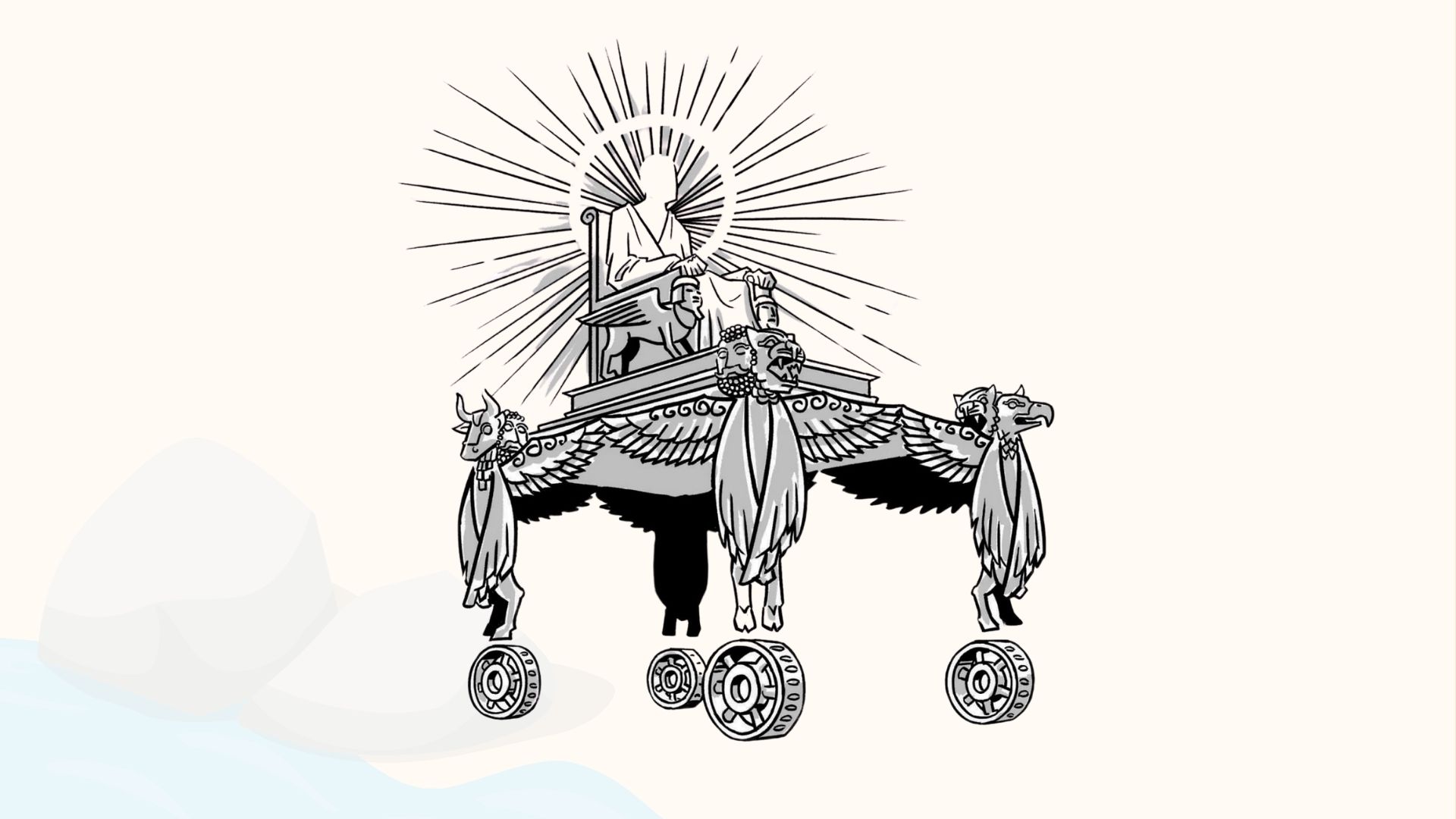
So these images to us may sound crazy, but they would have carried more meaning to Ezekiel. Here’s a little minimalist illustration that The Bible Project made of what Ezekiel’s vision could have looked like. You see the creatures Ezekiel describes are like legs of the throne that the presence of God is sitting on in this image. Obviously, we have no idea what it could have looked like aside from Ezekiel’s description, which can spark a lot in our imagination. The important takeaway though is this: God is big, God is powerful, and God is on the move.

God shows up where we least expect it. When we’re in those moments in our lives where we feel like everything is wrong – when our dreams have died, when all of our hard work hasn’t provided the results we wanted, when we’re grieving the sudden loss of a loved one or the end of a relationship – God can meet us there. God is not confined to the moments in our lives where everything is good or working out according to plan, and some of y’all in this room may know this from personal experience.

Psalm 34:18 The Lord is close to the brokenhearted and saves those who are crushed in spirit.

So God shows up in this powerful, overwhelming way to Ezekiel. But God doesn’t just show up to let Ezekiel know He’s there. God has a purpose for Ezekiel. God reveals himself to Ezekiel in a mighty way, and now he is commissioning Ezekiel with a new purpose.

Ez 2:1-8
He said to me, “Son of man, stand up on your feet and I will speak to you.” As he spoke, the Spirit came into me and raised me to my feet, and I heard him speaking to me.
He said: “Son of man, I am sending you to the Israelites, to a rebellious nation that has rebelled against me; they and their ancestors have been in revolt against me to this very day. The people to whom I am sending you are obstinate and stubborn. Say to them, ‘This is what the Sovereign Lord says.’ And whether they listen or fail to listen—for they are a rebellious people—they will know that a prophet has been among them. And you, son of man, do not be afraid of them or their words. Do not be afraid, though briers and thorns are all around you and you live among scorpions. Do not be afraid of what they say or be terrified by them, though they are a rebellious people. You must speak my words to them, whether they listen or fail to listen, for they are rebellious. But you, son of man, listen to what I say to you.

God raises Ezekiel up and gives him a purpose. Before this vision, Ezekiel has got to be feeling purposeless. The thing that he thought was going to be his purpose got ripped away from him. When you’re not near the Temple, there’s no need for a priest. But here, we see God meeting Ezekiel in his grief and giving him a new purpose.

In those moments in our life where we feel like we’re floating aimlessly, God wants to meet us there and reorient us to something better. God provides us a purpose. For Ezekiel, this looked like being a watchman for God, warning the people of the peril they would be facing for their evil and unrepentant ways. God tells him straight up, nobody’s going to listen to you. But that’s not your fault. Just be true to your purpose, and the results aren’t on you.

While this is probably a disheartening thing for Ezekiel to hear, I kind of find this message encouraging. We live in a results world. If you’re in business and you’re not making money, you’re not a successful business. If you’re a team that’s not winning games, you’re not a successful team. But God’s metrics aren’t our metrics. When God calls us to do something, we just got to do that thing, and trust that God’s going to work it out from there.

In these first chapters of Ezekiel, we see God show up in a place and in a way that Ezekiel would never expect, and in this way, God gives him a new purpose. While this isn’t an encouraging time to be an Israelite, this story can give us hope. When things look bleak, when we’re at the end of our rope, when things we hold onto are ripped away from us, God meets us there. And God wants to use us to work for redemption.

Each week we go to the Table together and remember Jesus who was God and came to meet us here on earth. Because Jesus fulfilled His purpose in living a perfect life, defeating death at the cross and rising again, we too get to have a purpose for more than what we can see in the here and now. Because of Jesus, like Ezekiel, God has come to us and given us purpose.

October 13th, 2024

Watch here: https://youtu.be/kPvs9RngXNs?si=S1dKszMdrzq0tKre&t=1459

Advent – Hope – Luke 21:25-28

Today, we are starting our Advent series, which we will be in for the next four Sundays leading up to Christmas. I’ll just take a moment here to say that if you have never really involved yourself in an Advent practice before, I would like to invite you into that this year. It’s easy to find a plan and do some short daily readings, the Bible App has a 25-day reading plan you can easily start today. __________________________________________________________

Luke 21:25-28

25 “There will be signs in the sun, moon and stars. On the earth, nations will be in anguish and perplexity at the roaring and tossing of the sea. 26 People will faint from terror, apprehensive of what is coming on the world, for the heavenly bodies will be shaken. 27 At that time they will see the Son of Man coming in a cloud with power and great glory. 28 When these things begin to take place, stand up and lift up your heads, because your redemption is drawing near.”

This is the text for week 1 of Advent this year. I don’t know about you, but this doesn’t sound like Christmas to me. What happened to the baby in the manger, no room in the inn, the star that showed the shepherds where to go? What happened to that Scripture that Linus reads in Charlie Brown Christmas? If you’re like me, this text seems out of place in this Christmas season.

I didn’t grow up in a church that practiced Advent, we weren’t like some Christians who didn’t acknowledge Christmas, but we didn’t do Advent. And I think that in this body here at New Garden, many of us are unfamiliar with Advent. We know it’s the time leading up to Christmas, but maybe not much else, so this morning I thought it might be helpful to briefly give some background on what Advent is and how it can help form our faith during this season.

Advent is the 4-week long anticipation and celebration of Christ’s birth and Christ’s return. Advent means arrival, so during this season we prepare ourselves for the arrival of Jesus, both God coming in the form of Jesus which we celebrate at Christmas, and we look forward to the arrival of Jesus again.

So a simple way that we can think of it is the same way that the Jews would’ve been hoping for and anticipating a Messiah before Jesus, we now hope for and anticipate Jesus’ return. So we do this Advent practice by reading Scripture, spending time in prayer, and reflecting on our need for a Savior.

Each week during Advent has a theme and different people do the themes in different orders, but just so we’re on the same page, we’re doing them in this order: hope, peace, joy, love, and then on the 29th with our friends at the Woodmont Hills Campus, we’ll celebrate the arrival or Advent of Christ. Today’s theme, as we’ve already mentioned is Hope.

Hope may seem like this abstract concept, but hope actually drives much of our behavior as humans. We take action in different ways because we are hoping for certain outcomes. We hope that brushing our teeth and flossing will keep our teeth and gums healthy. We hope that being a reliable and trustworthy worker will help us have job security and gain influence. We hope that the kindness we show to our neighbors will be reciprocated or at least appreciated.

And the fact that hope often drives us to good deeds, is concerning because sometimes the world that we live in can feel hopeless. In this room alone, we could probably share stories for days on end about moments in our life where we experienced serious disappointment. Times when we had put years of effort into a relationship only for it to fall apart. When we spent late nights studying but didn’t get the grade we wanted on the test. When we got laid off.

And to top it all off I’m sure all of us in this room if we’re being honest could identify a time in our life when we were disappointed because the thing that we prayed to God for and hoped for didn’t come through. The test results showed no improvement, that relationship is still strained at best, our desires haven’t been satisfied. And as Christians, as followers of Jesus, we have to live in that tension. We know we should hope in God, but we also know that we live in this unredeemed space.

And so, a lot of times we turn our hopes elsewhere. We put our hopes in other things to meet our needs, and our hopes are revealed in our actions. Country singer Luke Combs has a lyric: longneck, ice cold beer never broke my heart. And its not just vices that we turn to. We put our hope in systems, in ideas, in security. There’s a lot of people in our country who are really disappointed right now because of the election result. That thing that they were hoping for isn’t going to happen. And the other side, they got to experience that a few years ago.

As an escape from a world that seems hopeless, we put our hope in truly meaningless things like football. I hope you weren’t hoping in the Titans this year. If you were hoping in the Vols, you may be feeling ok right now but just wait… Hope is an unavoidable part of the human condition, so we all are hoping for something, putting our hope in something. What is that thing to us? To you? To me?

While we will experience inevitable disappointment here on earth, we can still have hope. Hope that God is going to redeem us. Hope that Jesus will arrive soon and set all things right.

There’s a preacher and author I’ve been taking in a lot recently named John Mark Comer. He describes hope in Scripture like this:
“The expectation of coming good based on the person and promises of God”

Notice that our hope, our expectation of coming good, is not based on us or our experiences. We have hope because of God and God alone. We cannot get ourselves to this coming good by trying harder. We cannot get ourselves to the goodness of God by voting for the right person. We cannot think or debate ourselves into a perfect society. This complete redemption only happens at the moment of Jesus return, and we can’t know when that’s going to be.

When I was growing up, I was not looking forward to Jesus coming back to earth. I had heard pieces of Scripture like the one I read earlier: nations will be in anguish and perplexity at the roaring and tossing of the sea. 26 People will faint from terror, apprehensive of what is coming on the world, for the heavenly bodies will be shaken. And that didn’t sound all that appealing to me. I’d lay in bed at night and if there was sirens going off or car horns, I’d go over to the window and look to the sky afraid that it might be time.

Dr. Earl Lavender who is one of the shepherds at the Woodmont Campus and teaches in the Bible department at Lipscomb said that in his formative years he would fend off Jesus’ return by mentioning in his prayers each night that he knew tonight was the night. The Bible says no one knows the day or the time so by letting God know he was expecting it, God had no choice but to wait til later.

And I think one thing that the Enemy enjoys about our society right now is our comfort. Why do we need to go to heaven? We’ve got iPhones and football and Thanksgiving leftovers in the fridge. We’re so insulated from pain and suffering unless its inside of our house that we rarely cry out, “Come quickly, Lord Jesus.” Over the last two thousand years, Christians have moved from daily hoping for Jesus’ return to accepting that it won’t be happening in our lifetime. But whether Jesus comes back today or in a thousand years, we should be hoping it’s today. Because it’s going to be awesome.

25 “There will be signs in the sun, moon and stars. On the earth, nations will be in anguish and perplexity at the roaring and tossing of the sea. 26 People will faint from terror, apprehensive of what is coming on the world, for the heavenly bodies will be shaken. 27 At that time they will see the Son of Man coming in a cloud with power and great glory. 28 When these things begin to take place, stand up and lift up your heads, because your redemption is drawing near.”

Don’t be afraid! Stand up, lift your heads, your redemption is drawing near. The moment we’ve been waiting for has arrived. We get to meet Jesus! This is good news.

Lord Jesus, Come Quickly.

Each week, we gather at the Table together remembering Jesus until His return by eating this bread and juice that symbolizes Jesus’ body and blood. This is just a placeholder. Someday we will get to share a meal with Jesus face-to-face. That’s exciting.

December 1st, 2024

Watch here: https://youtu.be/yirz_sGpXt0?si=Z_9-ORu6w2dzIKK7&t=1681

Advent – Joy – Luke 3:7-18

John said to the crowds coming out to be baptized by him, “You brood of vipers! Who warned you to flee from the coming wrath? Produce fruit in keeping with repentance. And do not begin to say to yourselves, ‘We have Abraham as our father.’ For I tell you that out of these stones God can raise up children for Abraham. The ax is already at the root of the trees, and every tree that does not produce good fruit will be cut down and thrown into the fire.”
10 “What should we do then?” the crowd asked.
11 John answered, “Anyone who has two shirts should share with the one who has none, and anyone who has food should do the same.”
12 Even tax collectors came to be baptized. “Teacher,” they asked, “what should we do?”
13 “Don’t collect any more than you are required to,” he told them.
14 Then some soldiers asked him, “And what should we do?”
He replied, “Don’t extort money and don’t accuse people falsely—be content with your pay.”

15 The people were waiting expectantly and were all wondering in their hearts if John might possibly be the Messiah. 16 John answered them all, “I baptize you with water. But one who is more powerful than I will come, the straps of whose sandals I am not worthy to untie. He will baptize you with the Holy Spirit and fire. 17 His winnowing fork is in his hand to clear his threshing floor and to gather the wheat into his barn, but he will burn up the chaff with unquenchable fire.” 18 And with many other words John exhorted the people and proclaimed the good news to them.

Luke 3:7-18

This is the text for week 3 of Advent. And its another text that may not seem like Christmas. But let’s remember, during Advent, we wait expectantly for the advent – or arrival – of Jesus. And these people here that John is baptizing they are also waiting expectantly. Waiting expectantly for the Messiah to come and be revealed. In fact, they think it might be John.

John was Jesus’ cousin, and he was born about six months before Jesus. John was also born in a miraculous way because his mother Elizabeth was old and unable to bear children. An angel appeared to John’s father Zechariah who was a priest, so it wasn’t a totally dissimilar experience from Jesus’ birth story.

But John knew what he was supposed to do. He knew he wasn’t the Messiah, he was just the one announcing the Messiah would come soon. There’s a lesson in there I think. We’ve got to know our role. We’re nobody’s savior, we’re just pointing people to Jesus.

And so during this Advent season, we can interpret John’s message as how to wait expectantly for Jesus.

“Anyone who has two shirts should share with the one who has none, and anyone who has food should do the same.”
“Don’t collect any more than you are required to,” 
“Don’t extort money and don’t accuse people falsely—be content with your pay.”

I hear this message from John pretty clearly: don’t have more than you need, don’t take more than you need. There’s enough for everybody. Be content and generous.

On the one hand, we’ve got these instructions from John about how to behave, and on the other hand, we’ve got our Advent theme for this morning: Joy. We know that the news of Jesus’ birth was good news that it would bring great joy to the world, and this time of year is one that brings a lot of joy. Fond memories of Christmases past. Excitement to watch that person open the gift that we got them. A couple days off work for most of us. Time spent with family we don’t see that often.

And we know those joys that we get to experience around Christmas. And yet, for a lot of folks, this Christmas will be a difficult time. We notice who isn’t going to be there on Christmas morning this year. We realize that Christmas is going to feel different this year than some of those fond memories of Christmas past. 

So how do we experience joy this holiday season? Does someone in our life get us a new Lexus with the big bow on top? Do we finally get the Red Rider BB Gun? I think John the Baptist would say, “take care of others.” “You’ve got too much stuff, give it to somebody else.” “You don’t need extra.”

This idea of simplifying your life and getting rid of your stuff isn’t only a Christian idea. Shows like Love it or List it and influencers like Marie Kondo have grown to prominence over the idea that having more stuff won’t make you happy. And it’s true that it won’t. But the joy that we’re talking about today is deeper than that. The joy that we’re talking about is only possible through a relationship with Jesus. A joy that transcends circumstances.

The apostle Paul is an example of this joy. In Colossians 1, he writes “Now I rejoice in what I am suffering for you.” He’s writing letters to churches from prison and yet he still has joy because he is connected to something far bigger than a self-help, simplify your life fad. When he met Jesus, everything changed. As a religious leader in the wake of Jesus death and resurrection, he was looking to imprison and kill followers of Jesus. But when he met Jesus on the road, his life was changed. He took on a new name. He was given a greater purpose. This joy that Paul was referring to was a deep, abiding joy.

So how do we get from where we are now to where Paul is. Where he can be in prison and still rejoicing. If you’re like me then being a joyful person is easier said than done. I experience a lot of joy when I’m here with you at 10am on Sundays, but what about when I’m running late on Monday? When I’m sick on Wednesday? When my boss makes a comment I don’t like on Friday?

It’s not going to be easy and it’s not going to be quick. Think of it like training to be a joyful person. If you decided today that you were going to run a marathon, you wouldn’t sign up for one on Saturday. You’d pick a date way out in the future because you know that it takes months to train. For me, I’d probably pick a date a few years off in hopes that everyone would forget I ever said that I was going to do that. But the first time you go running, you’re not ready for a marathon. And after a month of training 5 or 6 days a week, odds are you still won’t be ready to run a marathon, but your endurance is going to be way better than it was a month prior. It takes time, months, probably more like years, but you can become a joyful person.

So how? How are we going to do that? I’ve got a few suggestions. And I by no means am a finished product on this, but looking back, I can see how these things are forming me.

Ask God for Joy
This may seem obvious, but I think it’s important to mention. Like I said earlier, there’s a lot of stuff you can find out there in pop culture about how to be joyful, but that messaging is devoid of the provider of joy. God created joy for us to experience, and the deepest, most all-encompassing joy is found in God alone. So ask for it. God wants to give you joy.

Express Gratitude
This has been really helpful for me. In a world that wants to constantly remind us of all the stuff we don’t have, remind yourself of the good things in your life. When I’m pulling out of our neighborhood most mornings, I offer a simple prayer: thank you God for the work I get to do. There’s something in your life to be thankful for, express gratitude for it! Doesn’t have to be only through spoken prayer, for the journalers out there.

Practice Contentment
This is what John was talking about in our Scripture this morning. What you have is enough. Look for ways to provide for other people from your excess.

Remember Jesus Wins
We talked about this a couple weeks ago when we talked about hope. We know how the story ends. Jesus wins. Whatever our current circumstances may be, we have hope for a better future. We should be hopeful for Jesus’ return. Remembering this over and over and letting it sink deep down into our bones is going to bring us joy. And each week, we go to the Table together to remember Jesus. This should be a joyful time. I didn’t grow up in a church where talking during communion was acceptable. You passed the trays in silence. You could hear a pin drop. And growing up, I didn’t get the message that this was a time for rejoicing. I’m still learning more about what this time together at the Table means and how it can transform our lives. Jesus wins, and we can rejoice in that together this morning.


December 15th, 2024

Watch here: https://youtu.be/3rT5eldDJiw?si=RE7qvh42QKfBdEsN&t=859

Wait – Acts 1:1-8

As we begin the year, we’re going to be walking through Acts 1-15 together. We’re going to see God take this group of folks that was cowering in a dark room after Jesus Crucifixion and grow them into this big, bold, multi-national, multi-cultural group of Jesus like people. I know that maybe the more official title of this book is the Acts of the Apostles, but I think a more descriptive title of the book would be the Acts of the Holy Spirit.

___________________________________________________________________________

In my former book, Theophilus, I wrote about all that Jesus began to do and to teach until the day he was taken up to heaven, after giving instructions through the Holy Spirit to the apostles he had chosen. After his suffering, he presented himself to them and gave many convincing proofs that he was alive. He appeared to them over a period of forty days and spoke about the kingdom of God. On one occasion, while he was eating with them, he gave them this command: “Do not leave Jerusalem, but wait for the gift my Father promised, which you have heard me speak about. For John baptized with water, but in a few days you will be baptized with the Holy Spirit.”
Then they gathered around him and asked him, “Lord, are you at this time going to restore the kingdom to Israel?”
He said to them: “It is not for you to know the times or dates the Father has set by his own authority. But you will receive power when the Holy Spirit comes on you; and you will be my witnesses in Jerusalem, and in all Judea and Samaria, and to the ends of the earth.”

Acts 1:1-8

It’s the first week in January… This is the time of year where we all put our heads together to come up with a plan for how we’ll improve ourselves, how we’ll boost profits, how we’ll fix our businesses, our relationships, our churches. Because there’s a lot of work to do. There’s a lot of things to get done. There’s a lot of projects to get the ball rolling on, all that stuff when we said “we’ll circle back on this in the New Year” well now it’s time to start doing that thing we said we were going to do.

I personally have never been much for resolutions. I normally start well on January 2nd because I never know what I’m resolving to do until January 2nd, its not something I put thought to before then. And then I do really well for about 3 days. Then the 4th day I miss. Something comes up, and that thing that I was planning to do gets pushed aside for something more pressing or at least that’s what I tell myself. But I come back on day 5 ready to rock. Then two weeks later, that thing that I had resolved to do, I’ve totally moved on from.

And that frustrates me because every day all year long I see people sharing their wins. All this stuff that they’ve done and accomplished. Our culture values starting, going, trying, overcoming, succeeding, winning, to put it simply: doing. These values instilled in us from the time we are children: work hard, come up with solutions, if we’re not winning, we’re not trying hard enough.

And so, when something isn’t working. We try harder. We brainstorm. We spend more and more time trying to fix what it broken.

Our churches are not exempt from this. We’re not the only folks who come on Sundays and remember a time in our lives when there was more people in the room with us on Sundays. It’s happening all throughout our country. Each day we become a more secular society. And no political power grab is going to reverse that trend. And its not that our programs aren’t good enough. It’s not that churches aren’t doing enough things. Church growth strategies and church consultants are not the hope of the world. Even still in 2025 America, Jesus is the hope of the world.

We can’t try and do ourselves into going where God wants us to go. And this frustrates me and maybe you too.

In these first few verses of Acts, we see Jesus give a holy command to his disciples. And it’s not to scheme and plot how they’re going to grow church attendance. It’s not to go out and try really hard to win the approval of folks in town. Jesus tells them to wait. Wait expectantly for the Holy Spirit to move and when it comes, go where it’s taking you.

They’ve just been with Jesus for three years, walking with him, talking with him, seeing God work in mighty ways, and yet according to Jesus, they still need to wait. They need guidance from a source outside of themselves. Jesus knows that this new Kingdom He’s come to bring about is only possible with divine intervention and leadership. So he doesn’t take this time to give them a pep talk. He’s not saying you guys got this now that I’m leaving. He’s saying wait for more guidance. The Holy Spirit will lead you where you need to go.

There’s a book I got into last year titled, When Church Stops Working, it talks a lot about this problem that churches are facing as we move into a more secular time. Here’s a passage that connects with what we’re talking about today:

“In Acts 1:4 we read that the first command Jesus gives the disciples is “not to leave Jerusalem.” We might have expected that first command to be to go out, to witness, to start a program, to preach, to teach, to do something, anything, that would make the church bigger. But Jesus orders the disciples to stay in Jerusalem and wait. The real origin story of the church does not start in Acts 2 with progress and growth. The real origin story starts in Acts 1 with waiting for God to act. God is the hero, and the church waits.”

The problems we experience in our secular world do not require secular strategies, they need sacred solutions.

So I don’t think I’m really breaking any news here. Obviously, we need God to intervene in our world and the Holy Spirit to lead us. But how do we cultivate a culture where discernment alongside the Holy Spirit is our default mode? Now its common for us to have periods of discernment like when we are appointing new shepherds or something like that, but how do we become a group of people who naturally are attentive to and aware of the Holy Spirit’s direction in our midst? To borrow some language from Mark Love and his book It Seemed Good to the Holy Spirit and to Us, how do we become a sailboat instead of a rowboat? How do we as individuals become sails instead of oars?

Just for fun a couple images from pop culture come to mind. Here’s an image from the 1959 movie Ben-Hur. He’s depicted here as a prisoner in the bottom of a Roman ship where they were forced to row to keep the ship heading where it needs to go. Unfortunately, I think this is a great illustration for how we often attack problems both as individuals and as groups. Sayings like “if it is to be, it is up to me” tell us that with grit and determination we can exact our will on the world around us and bend it to be what we want it to be. Just keep rowing. I think this mindset leads us to a lot of places we were never meant to go. It leads to power grabs, burnout, and a lot of frustration when we don’t get the outcome we want.

On the other hand, here’s an image from one of Wesley’s favorite movies, Moana. Which one of these pictures looks like they’re having more fun? When we accept our role as a group of people being led by the Holy Spirit, we can walk forward into community with empty hands, willing to accept the moment we’re in and be transformed by God no matter what comes our way.

So how do we as a church community get from being a rowboat to a sailboat? What sort of practices can we begin now so that when there are needed moments of discernment and direction from the Holy Spirit, it’s not such a foreign concept to us?

We’ll talk about this at the end of our series, but in Acts 15, the apostles had to discern what to do in a big way. There were some people that thought one way and some people that thought another, but because they had taken on a lifestyle that was so dependent on the guidance and discernment of the Holy Spirit, they were able to meet the moment, and be in tune with what God’s plan was for the Church.

In his teachings from Practicing the Way, John Mark Comer claims that if we want to become like Jesus, we’ll have more success if we train well than if we try hard. To explain that simply, the idea is that if you just wake up every day and try to be like Jesus, that’s great and good, but if you have not been committing yourself to the spiritual disciplines of prayer, meditating on Scripture, fasting, giving, and living in community with other believers, going out and being like Jesus will be frustrating to you because you will fail. On the other hand, when your heart has been transformed by the Holy Spirit through these spiritual disciplines, being like Jesus will be far easier for you, because you will already have been transformed into someone more like Jesus than you are right now.

So as we enter into a New Year here together today, my invitation to you is not to pick up a flyer on your way out that outlines our 2025 strategic plan for improvement and growth. Instead, I am inviting you to envision a church that walks in step with the Spirit, and help us take a step in that direction by engaging deeper in spiritual practice this year. That may be participating for the first time in a practice of Sabbath. Setting aside time in your week outside of Sunday morning removed from the workings and worries of your day-to-day life where you can spend time intentionally with God and your family or a close circle of friends. It may be praying each day for the first time in your life when you wake up, when you go to work, when you go to sleep. It may look like reading Scripture in community with other believers as part of a Bible Reading Group. It may be fasting from something in your life to make more room in your heart, your calendar, your wallet for the Kingdom of God.

And now we point ourselves towards the Table, the spiritual practice that we do together each week as we wait expectantly for the return of Jesus. All are welcome to come and share communion with us around one of our tables today.


January 5th, 2024

Watch Sermon: https://youtu.be/y8RdOEz9XPs?si=HeHO7gwHWWqYknZS&t=1632